
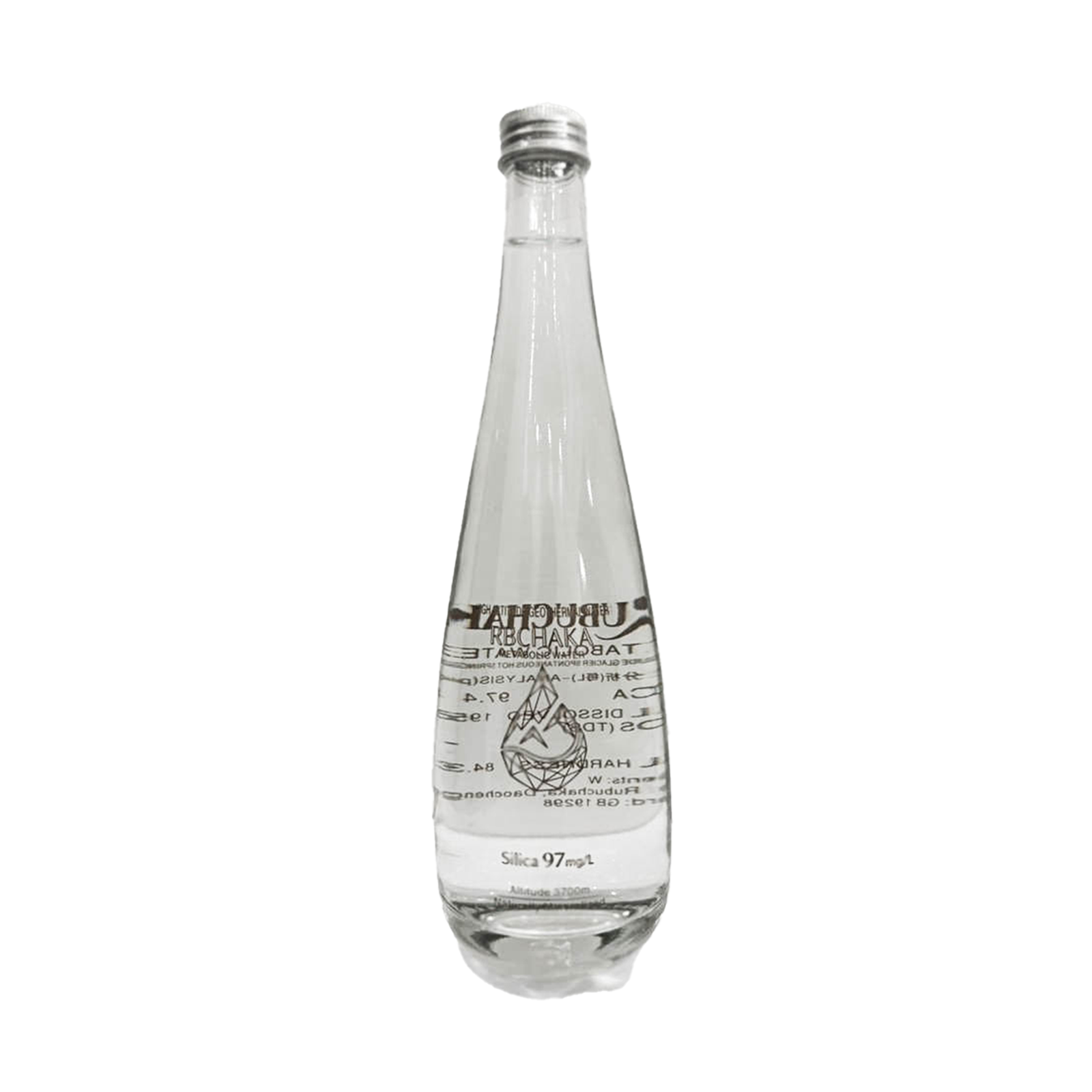
Rubuchaka Water Analysis:
| Balance | Still |
| Virginality | Superior |
| Minerality | Low |
| Orientation | Neutral |
| Hardness | |
| Vintage | |
| Carbonation | |
| TDS | 195 mg/l |
| ph factor | 7.1 |
| Hardness | |
| Nitrate | < 0.05 |
| Calcium | |
| Magnesium | |
| Sodium | |
| Potassium | |
| Silica | 97 mg/l |
| Bicarbonate | |
| Sulfate | 1 mg/l |
| Chloride | 2 mg/l |

Rubuchaka is a Member of the Fine Water Society |
|
| Source: | Artesian |
| Location: |  |
| Country of Origin: | China |
| Region: | Garzê Tibetan Autonomous Prefecture |
| Place: | Rubuchaka (茹布查卡) |
| Established: | 2026 |
| Company: | Sichuan Rubuchaka Drinking Water Co., Ltd. |
| Status: | Active |
| Web Site: | www.rubuchaka.cn |
| phone: | +86-18908321035] |
| email: | |
| Social Media: |
Long ago, a once-in-a-century drought and plague struck Daocheng Yading, splitting the earth and stripping the land of life. As illness and thirst spread through the valleys, three Tibetan sisters—remembered as celestial maidens and guardians, akin to Western mythology’s Three Graces—looked down from the sacred mountain with a compassion that would not let them turn away. Drawn by the cries of the suffering, they descended to Rubu Village, where the people pleaded not for riches, but for warmth and relief.
Yet the only water was a stream: clear, pure, and painfully cold. The sisters could not heat it, and they returned to the heavens burdened by regret. The villagers, however, persisted—burning incense, kneeling in prayer, and holding to hope until devotion itself became a force. Moved at last, the sisters came again, journeyed upstream, and chose sacrifice: transforming into three scorching stones so the icy current could pass over them. Their warmth softened the waters into a gentle spring, and their tears, the story says, turned sweet as mineral water.
From then on, Rubu Stream flowed as a life-giving hot spring—steaming in summer, misting the winter air like a dream. People cooked and brewed butter tea with it, bathed in it, and credited it with easing ailments, brightening skin, and extending life, until Rubu was known as “Longevity Village.” In gratitude, the spring was named Rubuchaka—“The Friend’s Spring”—and the three stones beside it, Bumu Bensong, the Three Sisters, still honored with offerings. Today, that reverence is paired with modern understanding: at more than 3,700 meters elevation, water rises crystal-clear from deep granite fracture zones shaped by the Himalayan orogeny, naturally mineralized over decades and rich in Metasilicic Acid, a rare functional component associated with metabolic support—an ancient blessing, reframed as a modern “metabolism management” water shared with the sisters’ dearest friends.
Awards
